


 Cart
Cart
 sales@molnova.com



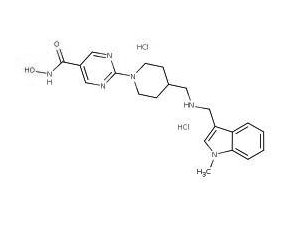
Quisinostat 2HCl
CAS No. 875320-31-3
Quisinostat 2HCl( —— )
Catalog No. M17639 CAS No. 875320-31-3
Quisinostat (JNJ-26481585) 2HCl is a novel second-generation HDAC inhibitor with highest potency for HDAC1 with IC50 of 0.11 nM in a cell-free assay.
Purity : >98% (HPLC)
 COA
Datasheet
HNMR
HPLC
MSDS
Handing Instructions
COA
Datasheet
HNMR
HPLC
MSDS
Handing Instructions
| Size | Price / USD | Stock | Quantity |
| 5MG | 116 | In Stock |


|
| 10MG | 204 | In Stock |
|
| 25MG | 314 | In Stock |
|
| 50MG | 411 | In Stock |
|
| 100MG | 593 | In Stock |
|
| 200MG | Get Quote | In Stock |
|
| 500MG | Get Quote | In Stock |
|
| 1G | Get Quote | In Stock |
|
Biological Information
-
Product NameQuisinostat 2HCl
-
NoteResearch use only, not for human use.
-
Brief DescriptionQuisinostat (JNJ-26481585) 2HCl is a novel second-generation HDAC inhibitor with highest potency for HDAC1 with IC50 of 0.11 nM in a cell-free assay.
-
DescriptionQuisinostat (JNJ-26481585) 2HCl is a novel second-generation HDAC inhibitor with highest potency for HDAC1 with IC50 of 0.11 nM in a cell-free assay, modest potent to HDACs 2, 4, 10, and 11; greater than 30-fold selectivity against HDACs 3, 5, 8, and 9 and lowest potency to HDACs 6 and 7. Phase 2.(In Vitro):JNJ-26481585 inhibits HDAC isozymes in vitro.JNJ-26481585 (30-1000 nM; 24 hours) is a potent pan-HDAC inhibitor in tumor cells.JNJ-26481585 has broad spectrum antiproliferative activity against solid and hematologic cancer cell lines and induces apoptosis.(In Vivo):JNJ-26481585 (40 mg/kg; p.o.; once daily, for 3 days) as a potent HDAC1 inhibitor p21waf1,cip1 ZsGreen tumors in vivo.JNJ-26481585 induces continuous H3 acetylation in tumor tissue in vivo.JNJ-26481585 (10 mg/kg; once daily; i.p.; for 14 days) strongly inhibits the growth of large pre-established HCT116 colon xenografts.
-
In VitroJNJ-26481585 inhibits HDAC isozymes in vitro.JNJ-26481585 (30-1000 nM; 24 hours) is a potent pan-HDAC inhibitor in tumor cells.JNJ-26481585 has broad spectrum antiproliferative activity against solid and hematologic cancer cell lines and induces apoptosis. Western Blot Analysis Cell Line:Human A2780 ovarian carcinoma cells Concentration:30 nM, 100 nM, 300 nM, 1000 nM Incubation Time:24 hours Result:Induced H3 and H4 acetylation at concentrations as low as 30 to 100 nM.
-
In VivoJNJ-26481585 (40 mg/kg; p.o.; once daily, for 3 days) as a potent HDAC1 inhibitor p21waf1,cip1 ZsGreen tumors in vivo.JNJ-26481585 induces continuous H3 acetylation in tumor tissue in vivo.JNJ-26481585 (10 mg/kg; once daily; i.p.; for 14 days) strongly inhibits the growth of large pre-established HCT116 colon xenografts. Animal Model:NMRI nude mice, with HCT116 colon carcinoma cells xenografts Dosage:10 mg/kg Administration: Intraperitoneal injection, once daily, for 14 days Result:Strongly inhibited the growth of large pre-established HCT116 colon xenografts.
-
Synonyms——
-
PathwayMetabolic Enzyme/Protease
-
TargetRetinoid Receptor
-
RecptorHDAC1| HDAC10| HDAC11| HDAC2| HDAC4
-
Research AreaCancer
-
Indication——
Chemical Information
-
CAS Number875320-31-3
-
Formula Weight467.39
-
Molecular FormulaC21H28Cl2N6O2
-
Purity>98% (HPLC)
-
SolubilityIn Vitro:?DMSO : 31.25 mg/mL (66.86 mM)
-
SMILESCl.Cl.CN1C=C(CNCC2CCN(CC2)C2=NC=C(C=N2)C(=O)NO)C2=CC=CC=C12
-
Chemical Name——
Shipping & Storage Information
-
Storage(-20℃)
-
ShippingWith Ice Pack
-
Stability≥ 2 years
Reference
molnova catalog



related products
-
CD2665
CD2665 is an antagonist of RAR-beta/gamma (Ki: 110 nM and 306 nM for RARγ and RARβ).
-
PA452
PA452 is a retinoic X receptor (RXR) specific antagonist. PA452 suppresses the effect of Retinoic acid (RA) on Th1/Th2 development.
-
Fenretinide
Fenretinide (4-HPR) is a synthetic retinoid deriverative. 4-HBR is shown to exhibit binding to the retinoic acid receptors (RAR) at concentrations necessary to induce cell death.
